Friday, February 21, 2020

Thursday, February 20, 2020
The #1 Misconception in the Homebuying Process

After over a year of moderating home prices, it appears home value appreciation is about to reaccelerate. Skylar Olsen, Director of Economic Research at Zillow, explained in a recent article:
“A year ago, a combination of a government shutdown, stock market slump and mortgage rate spike caused a long-anticipated inventory rise. That supposed boom turned out to be a short-lived mirage as buyers came back into the market and more than erased the inventory gains. As a natural reaction, the recent slowdown in home values looks like it's set to reverse back.”
CoreLogic, in their January 2020 Market Pulse Report, agrees with Olsen, projecting home value appreciation in all fifty states this year. Here’s the breakdown:
- 21 states appreciating 5% or more
- 26 states appreciating between 3-5%
- Only 3 states appreciating less than 3%
The Misconception
Many believe when real estate values are increasing, owning a home becomes less affordable. That misconception is not necessarily true.
In most cases, homes are purchased with a mortgage. The current mortgage rate is a major component of the affordability equation. Mortgage rates have fallen by almost a full percentage point since this time last year.
Another major piece of the equation is a buyer’s income. The median family income has risen by 5% over the last year, contributing to the affordability factor.
Black Knight, in their latest Mortgage Monitor, addressed this exact issue:
“Despite the average home price increasing by nearly $13,000 from just over a year ago, the monthly mortgage payment required to buy that same home has actually dropped by 10% over that same span due to falling interest rates…Put another way, prospective homebuyers can now purchase a $48K more expensive home than a year ago while still paying the same in principal and interest, a 16% increase in buying power.”
Bottom Line
If you’re thinking about purchasing a home, realize that homes are still affordable even though prices are increasing. As the Black Knight report concluded:
“Even with home price growth accelerating, today’s low-interest-rate environment has made home affordability the best it’s been since early 2018.”
Wednesday, February 19, 2020
The Many Benefits of Aging in a Community

There’s comfort in being around people who share common interests, goals, and challenges. That comfort in a community doesn’t wane with age – it actually deepens. Whether it’s proudly talking about grandchildren or lamenting the fact that our eyes aren’t as good as they used to be, it helps to be around people who not only understand what we’re saying but actually feel the same joys and concerns as well.
That’s why many boomers are deciding to move into an active adult community. In the latest 55places National Housing Survey, they were described by one out of three seniors as an “outgoing, social community of likeminded people.”
Bill Ness, Chief Executive Officer and Founder of 55places.com, explains:
“Baby boomers are now reaching the age when moving to an active adult community is the ideal opportunity for them…Many boomers now want to downsize, experience a maintenance-free lifestyle, and pursue more social opportunities. It’s exciting that there are so many choices for baby boomers.”
There’s still a desire, however, among many seniors to “age-in-place.” According to the Senior Resource Guide, aging-in-place means:
“…that you will be remaining in your own home for the later years of your life; not moving into a smaller home, assisted living, or a retirement community etcetera.”
The challenge is, many seniors live in suburban or rural areas, and that often necessitates driving significant distances to see friends or attend other social engagements. A recent report from the Joint Center for Housing Studies of Harvard University (JCHS) titled Housing America’s Older Adults addressed this exact concern:
“The growing concentration of older households in outlying communities presents major challenges for residents and service providers alike. Single-family homes make up most of the housing stock in low-density areas, and residents typically need to be able to drive to do errands, see doctors, and socialize.”
The Kiplinger report also chimed in on this subject:
“While most seniors say they want to age in place, a much smaller percentage of them actually manage to accomplish it, studies show. Transportation is often a problem; when you can no longer drive, you can’t get to medical appointments or to other outings.”
Driving may not be a challenge right now, but think about what it may be like to drive 10, 20, or 30 years down the road.
There are also health challenges brought on by a possible lack of socialization when living at home versus a community of seniors. Sarah J. Stevenson is an author who writes about seniors. In a recent blog post for A Place for Mom, she explains:
“Social contacts tend to decrease as we age for reasons such as retirement, the death of friends and family, or lack of mobility.”
Thankfully, research from the same article suggests if you’re spending time with others in a community, thus reducing the impact of loneliness and isolation, there’s less of a risk of developing high blood pressure, obesity, heart disease, a weakened immune system, depression, anxiety, cognitive decline, Alzheimer’s disease, and early death.
Though the familiarity of our current home may bring a feeling of warmth, comfort, and convenience, it’s important to understand that staying there may mean missing out on crucial socialization opportunities. Living with adult children, joining a retirement community, or moving to an assisted living facility can help us continue to be with people we enjoy every day.
Bottom Line
“Aging-in-place” definitely has its advantages, but it could mean getting “stuck-in-place” too. There are many health benefits derived from socialization with a community of people that shares common interests. It’s important to take the need for human interaction into consideration when making a decision about where to spend the later years in life.
Tuesday, February 18, 2020
How Trusted Professionals Make Homebuying Easier to Understand

In the spring, many excited buyers get ready to enter the housing market. Others continue dreaming about the homes they’d like to buy. The truth is, many potential buyers continue to dream longer than they need to, simply because they’re confused about the homebuying process. Thankfully, working with a trusted real estate professional can help ease those concerns and make the process to homeownership much easier to understand.
A recent survey conducted by Ipson and Freddie Mac reveals the confidence level of Gen Z and Millennial buyers regarding the homebuying process. The graph below shows the breakdown of the top results, clearly indicating there’s a significant portion of younger buyers who are not yet confident with some of the steps in the homebuying process.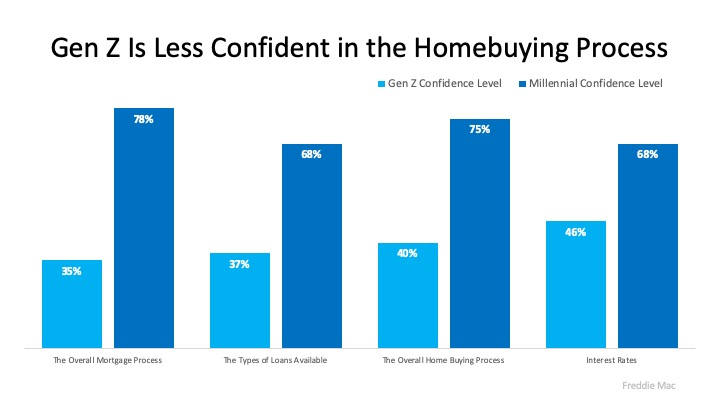 Between the homebuying process and the mortgage process, there are 230 possible steps in the transaction. With trusted professionals on your side, you certainly don’t have to know them all to have a successful experience.
 Between the homebuying process and the mortgage process, there are 230 possible steps in the transaction. With trusted professionals on your side, you certainly don’t have to know them all to have a successful experience.
There are many reasons why these steps can change as you move through each one. Depending on your personal circumstances, the term or your mortgage, and the type of loan you use, the path you take may need to vary. That’s why guidance and support from the experts is key.
In addition to the process itself, respondents in the survey definitely expressed concerns about understanding the types of loans available. Here are just a few of the basic loans to consider. Be sure to speak with your lender about the specifics of what will work best for you:
- FHA: Loans guaranteed by the Federal Housing Administration for first-time buyers. They generally enable qualified borrowers to enter the housing market with a lower down payment.
- Conventional: Loans that usually require a larger down payment. Repeat buyers usually use these types of loans since they have an established credit history as well as more money from the sale of their previous home (called equity) for a bigger down payment.
- VA: Loans available for Veterans of the U.S. Armed Forces and their spouses. They are guaranteed by the Department of Veteran Affairs.
- USDA: Loans for those living in rural and suburban areas. A qualified lender can issue a USDA home loan, and they are guaranteed by the United States Department of Agriculture (USDA).
Interest rates also popped up as a common area of confusion among Gen Z and Millennial respondents in the survey. With today’s rates hovering at near historic lows, it’s a fantastic time for buyers to get more house for their money in the current market. Why? When mortgage rates are this low and wages are increasing as they are today, overall affordability increases, enabling home buyers to stretch their mortgage dollars further. It’s just another area where a trusted professional can help simplify the process and give guidance along the way.
Bottom Line
There are many possible steps in a real estate transaction, but they don’t have to be confusing. To understand your best course of action, let’s get together today to ensure you have a trusted advisor who will help you feel confident and informed at every turn.

Monday, February 17, 2020

Sunday, February 16, 2020

Subscribe to:
Posts (Atom)

